Get ready for changing seasons, land-clearing, egg-onomics, dove hunting, and Gus’ new shoes.
Make hay while the sun shines, or in our case clear land while the weather’s fair. September brought a breath of cool (less humid) air, a delivery of four new hives, more stump excavating, doves, and an abundance of eggs. Gus got a new pair of pour-in shoes while my own paddock boots cracked and split.
Dove season was an exciting time. A cover of millet, sunflowers, and volunteer clover was too tasty for the doves to ignore. Lilli had the chance to put last year’s Christmas present (20 ga) to work and a happy Chet tracked the fallen birds through grass, brambles, and brush.
A friend brought four more hives to weather the winter at Glendale. They are not the strongest but hopefully will be able to take advantage of blooming golden rod over the next few weeks. Our good neighbor Paul Jones will bring feed to give them a better chance of survival. If any fail, the empty hive will be available for spring swarms to colonize. Life finds a way!
Paul Jones brought over four new hives to spend the winter.
Land clearing continued as the cooler weather has made the work less sweaty. Over the past 12 months, Brendan has cleared about 5 1/2 acres and we have plans to open another 4 1/2. We’ll divide the 10 acres into several paddocks with the intent to not only bring Gus home but also purchase a few cattle. Brendan is considering Angus but we’ll see what happens. We still have stumping, grading, planting, and fencing before we introduce more feet! Next month, Barry plans to bring over a small bulldozer (Cat 450) which will help the process along. With both Brendan and I fully employed, it’s going to take some night farming to make it happen.
The 9 chickens laid a record 229 eggs this month. We’ve been fortunate to gift eggs to neighbors and friends, and have even color-coded them: the Wyandott lay a beige egg, the Golden Comets produce a large brown egg, and the Leghorns gift us giant white dobbers. Like most hobby chicken tenders, we’ve run out of egg cartons and have taken to lending small baskets or wrapping them in paper.
Chickens visiting the home SEARCH office.
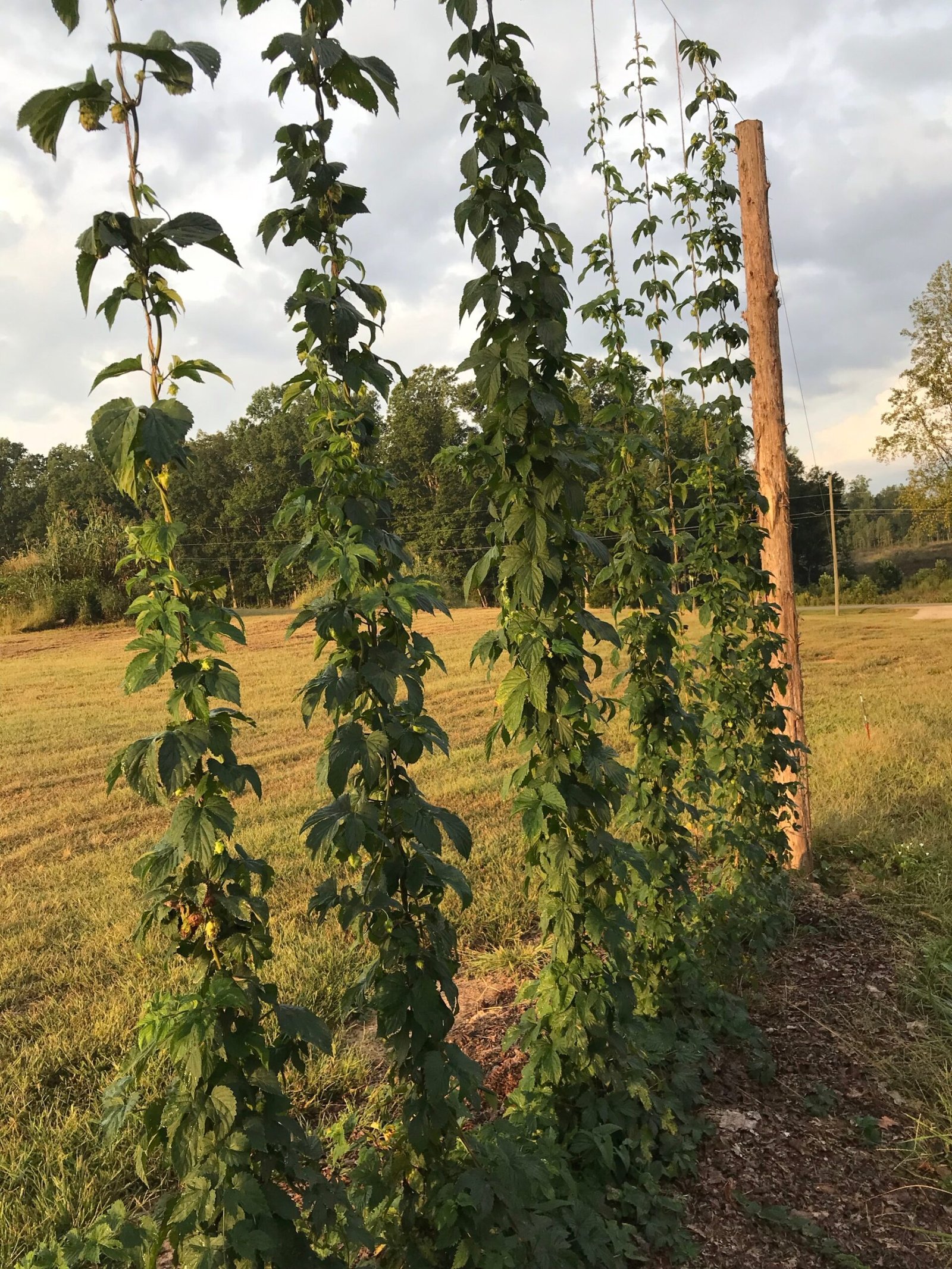
We picked 6.5 oz of hops from the Centennial hops mid-month. The Golding didn’t produce but that’s not uncommon for the first year. We’ll leave the hop bines standing until the first frost to encourage as much growth and energy storage as possible. The wet hops went into a 10-gallon batch of Farmhouse Ale for the second fermentation. We’ll keg it in early October and enjoy it for OctoberFest.
Hop cones ready for harvesting
The first apples are ripe and ugly. Thanks to the deer and wasps, there are too few to bother with cider but we did find a pulley and belt at the Somerset Steam and Gas show. We’ll attach it to the hit and miss engine next fall to run the cider mill. This year we’ll satisfy our curiosity by picking the best apples and deciding which varieties we like best.
Last but not least, Gus got some fancy kicks. Being a first time horse owner, it’s been quite the learning process. He pulled a shoe and had underrun his heels a couple of weeks ago. We tried going barefoot but I finally caved in. The new shoes will support his frog and give his heels a chance to recover.We’re lucky to be in a part of the country with good care and a great farrier.
Let’s be clear. If you ask this question to a 100 horse owners you’ll get a hundred answers and every response will be right. That said, unless you’re the type that would “rather just not know” it’s nice to have some numbers. I thought I’d share my experience – as a first time horse owner and someone who grew up always thinking that owning a horse was something I could never afford to do.
Yes, owning a horse is expensive. There’s no question that everything involved with a 1,080 lb animal is going to cost more. On a fundamental level, Gus weighs 8.3X as much as me. That means he takes 8.3X as much medicine when he’s sick and his portions are weighed in pounds rather than ounces. He also has the rough and tumble habits of a four year old, extremely sensitive skin, and is impossibly engineered (but that’s another post).
A bit of context. The costs of owning a horse vary widely. We live in central Virginia – near horsey country but far enough away that most costs are reasonable (ish). Depending on where you live some items, such as feed or board, could cost a lot more.
I’ve broken costs into eight categories: Board, Clothing (for me), Farrier, Fist Aid, Vet, Feed, Tack, Training, and Misc. We’re planning to move Gus from his boarding barn to Glendale in the next 12-18 months and while we’ll save money on board, we’ll be installing $10-$15K for infrastructure (i.e. fences, gates, shelter, water) and we’ll still need to provide items like hay and bedding that are currently part of his board. It will definitely be a short-term increase in cost.
BOARD
We were unbelievable lucky to find this place! Wig Wam is an 18th century historic home in Amelia County that used to be home to Governor Giles. It’s not the fanciest barn but has big pastures, several miles of trails, a nice outdoor arena with lights, and no drama. I was welcomed as a beginner rider and have been supported every step of the way. Right now, board varies from $190 for pasture board to $390 for stall board, including grain. Gus and I pay $350 and I provide his grain and supplements. I also help out and work a couple of shifts each month with the feeding and turnout (25-30 horses) which takes a little bit off the total.
FEED AND SUPPLEMENTS
Thoroughbreds aren’t known for being easy keepers but Gus is pretty good. His first year, I spent an average of about $100/month on his grain and supplements. He lost weight during the winter and we increased his morning and evening feed to 3 lbs per feeding and added 1 oz cool calories (fat), and about 1 lb of alfalfa pellets. I also give him a hoof and joint supplement. I figure an once of prevention is a pound of cure.
CLOTHING
Equestrian clothing is expensive. On the bright side it tends to be well made and lasts if you take care of it. My clothing list doesn’t include a few things I had from before- paddock boots, tall boots, breeches, helmet, and riding gloves. Not exactly part of the cost of ‘owning a horse’ but if you’re going to ride, then they’re kind of important. The Air Pro 2 vest is my life-jacket – literally inflates on separation from the horse and protects my vital bits from impact. I started riding as an adult and I learned the hard way that I’m likely to break before I bounce.
TACK
Clothing for your horse! Some months I don’t buy anything and then other times I do. It averages out to about $50/month. Bits and pieces from the “essential” fly mask to the fun new saddle pad. No, I didn’t actually use the side saddle but I had a fun time shopping for it and learning about it!
FARRIER
Gus’ Jockey Club Name is “My Sweet Prince” and he is an outstanding Thoroughbred (TB). Like most outstanding TBs, Gus has tender feet. He’s been barefoot and was barefoot in Florida, but came up sore and lame in both front feet about 12 weeks after moving to Virginia. I caved in and he’s been in front shoes ever since. I love seeing him sound and galloping across the pasture. I don’t love the $100-$110 for shoes (vs. the $45 for a trim) every 5-6 weeks. We may try to transition him to barefoot this winter but it’s a long-term goal and for now, he’s just a happier horse in shoes.
TRAINING AND EDUCATION
A horse is always learning what they can get away with and unless you’re reinforcing good behavior, your doing something else… Lessons where I am range from $40 to $70, with the higher end consisting of a one-of-one training session with the instructor coming to barn and working with me and Gus for over an hour. It’s a great way to get back on track and have someone put eyes on what I don’t even realize I’m doing wrong. It’s also great for confidence.
In addition to lessons, I bought a lot of books- reference books for pasture management, books on riding techniques, and books that are just fun. In my opinion, it’s all educational and printed material is so much more reliable than the internet!
I spent $124 in 2020 on training but…. ended up in ICU with a broken back and a bill for my out of pocket maximum. Without insurance the bill would have been over $50,000. If there’s one thing I learned it’s not to ride if you don’t have health insurance. In 2021, I decided to invest more in lessons!
FIRST AID
Every horse owner needs a first aid kit (and a friend who can show them how to use it). I can usually tell how good the horses are feeling by the marks and scuffs they sport. They don’t call it horse play for nothing!
The most common first aid items I buy are preventative – fly spray, antifungals (that Gelding funk!), wormers, and hoof hardeners. Other basic items on hand for the inevitable abscess are Epsom salt, duct tape, and diapers (for wrapping hooves, not for messes). Spray-on Band-Aids and Corona cream are great for little cuts and anything that doesn’t need a vet. I’ve learned that horses generally heal well, but only if you can keep the wound from getting infected. $272 spent.
VET
Sometimes you can’t fix it and you shouldn’t try. Plan on Spring and Fall shots, maintenance dentistry (floating the teeth), and at least one whoopsie. In Gus’ case, we’ve been pretty lucky that he’s come up lame at the same time we had a regular vet visit. The farm call for coming out has been between $40 and $55. It depended on the vet and where they’re based. At the barn, we save a little money by combining farm calls and splitting the call-out fee. Over the year, I spent $669.
Board
3847.75
Monthly full board ($350/month) includes hay and stall
4225
Barn help in September
-158
Barn help in October
-123.75
Barn help in November
-95.50
Clothing
457
Clothes for riders
140
Pad, half pad, neck warmer
67
Point 2 Air Pro Vest, Used
250
Farrier
830
Front shoes (every 5-6 weeks) x 8 times
First Aid
272.95
32 oz hoof kevlar ($25)
28
Banixx
20
Betadine and Saline Wash
31
Bot knife
4
Coat Defense and Wormer
38.95
Epsom salt and hoof pad
14
Fly spray
72
Ivermectin for June worming
10
MTG
20
Panacur Wormer
13
Pyrantel dewormer
10
Safeguard dewormer
12
Misc
22
Feed bucket
6
Jolly Ball
16
Supplement/Feed
1169.69
500# Blue Seal LS Performance Feed
464
2 bales alfalfa from David Smith
18
30# Redmond Gold ($65)
94
Alfalfa Cubes (40 lbs)
18
Alfalfa Pellets (50 lbs)
32
Cool Calories, 8 lbs
29
FlexMax (25 lbs) Joint Supplement
287.89
Manna Pro (10 lbs) Hoof Supplement
216.5
Tractor Supply – Salt Lick
10
Tack
526
Bell Boots
19
Blanket cleaner and waterproofing ($50);
51
Effax lether balm and cleaner
40
Kavallier saddle pad
67
Leather bit replacement
8
Leg Straps
12
Lunge whip, dressage whip, manure scoop
68
New fly mast ($28) + shipping
32
Reins
45
Side Saddle and Saddle Soap (for fun)
106
Training halter
78
Training/Education
124
Horsekeeping on Small Acreages
6
How to think like a horse
8
Lesson
60
Lesson/Trail Ride
40
Manual of Horsemanship
10
Vet
669
Exam; Teeth Float
268
Vaccines and lameness test
266
Vet Chiropractic adjustment
135
Grand Total
7918.39
So that’s about it. I started this draft a year ago and will provide an update sometime soon. With all new things there’s a learning curve and I spent more the first year than the second (or third).